


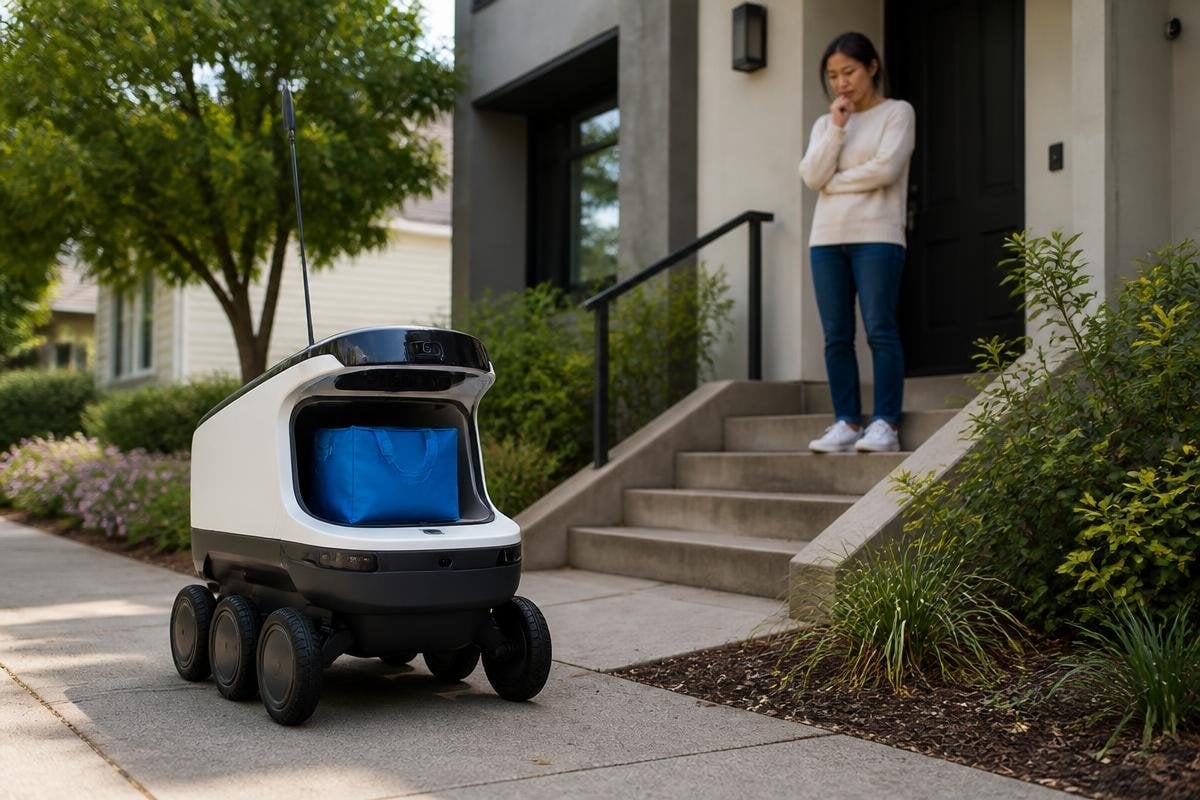
A grocery robot can reach your street and still fail at the final 10 metres. The hard part is moving a cold bag off a vehicle or sidewalk unit, then getting it to the correct door at the promised time without a person fixing each mistake.
Quick read
- A useful service needs a clear delivery area, payload limit, and time window.
- The robot must handle curbs, doors, lifts, weather, and people safely.
- The business case depends on trips per robot, not the robot alone.
The delivery route is only half the job
The service starts with a route from a store or local hub. That route may use an autonomous vehicle, a small sidewalk robot, or a larger vehicle that carries several orders. The exact design matters less than the handoff at the end.
A doorstep has steps, narrow paths, parked cars, loose gravel, pets, and doors that open in different ways.
To handle these obstacles, a delivery robot needs sensors to detect them, software to choose a safe path, and a way to pause when the route is blocked.
The order also has physical limits. A service needs to state the payload in kilograms, the maximum travel distance, and the temperature range for chilled or frozen items. Without those figures, you can’t tell if the robot fits a weekly shop, a small top-up order, or neither.
The customer handoff needs a plan
The robot must identify the right customer and release the order at the right place. That could involve a phone code, a remote operator, or a locked storage compartment that opens after the customer confirms receipt.
Each method creates a different job. A phone code may work for one person but fail when someone else collects the order. A locked compartment protects the bags, but its size limits the order. Remote help can solve unusual cases, though the service then still depends on people.
Grocery delivery also has a timing problem. A robot that reaches a building early may wait outside with food inside. Late arrival can miss the customer’s available time. A useful service needs a stated delivery window, a plan for missed handoffs, and a clear refund process when the order cannot reach the door.
A grocery robot’s route can end at a locked door or steep curb, leaving the customer to collect food outside. Robot24.com grocery robotics reporting can tie delivery claims to named machines, trial sites, and handoff results before safety and access set the service area.
Safety and access shape the service area
Coverage won’t work everywhere at once. Operators may begin with streets that have wide pavements, smooth crossings, and buildings with step-free access. That keeps the route easier to map and gives the service fewer unusual cases to handle.
This creates a practical limit for customers. A robot may serve one housing area while leaving the next street to a human driver. A building with a lift may still need a person if the robot can’t open the main door or reach the correct floor.
Weather adds another test. Rain can affect cameras and braking. Ice can reduce grip. Heat can affect food temperature and battery life. Any service plan should state the conditions that stop delivery, rather than treating every route as equal.
The strongest safety plan also covers people nearby. The robot needs a safe speed, a visible stop state, and a remote help process when a child, wheelchair user, cyclist, or parked vehicle blocks its path. Those details shape public trust more than a top speed figure.
The business case needs public numbers
A delivery robot costs money before it carries a single bag. The operator must account for the robot, charging, repairs, remote support, insurance, mapping, and staff who load or recover units.
The useful measure is the cost per completed order. That number depends on how many trips one robot makes, how often it stops for help, and how much time staff spend handling exceptions. A lower robot price won’t fix a service that needs a person beside every unit.
I’d wait for a service to publish completed deliveries, failed handoffs, remote-assistance time, and the share of orders that need human recovery. Those figures tell you more than a launch video.
A checklist for judging a real service
Before you trust a grocery robot with a regular order, check:
- Service area: Is your exact street included, including the building entrance?
- Payload limit: Can the compartment carry the weight and size of your usual order?
- Food control: How does the service protect chilled and frozen items during delays?
- Handoff method: What opens the compartment, and what happens if the code fails?
- Recovery plan: Who helps when the robot meets a blocked path or cannot reach you?
- Published results: Are delivery success, delay, and human-assistance figures available?
The next useful proof is a full service record covering ordinary deliveries, failed handoffs, weather stops, and the cost of human help. Until those numbers are public, robot-powered grocery delivery remains a service to test in a small area, not a replacement for every grocery route.